
Key Takeaways
- In a sole proprietorship, there's no legal separation between the owner and the business; liability is unlimited.
- Low formation cost, fast setup, and easy closure are the main advantages of a sole proprietorship.
- It can create a more limited perception of corporate credibility compared to a limited company.
- With the right documents, the formation process is typically completed within a few business days.
One of the most common questions when starting a new business is “should I set up a sole proprietorship?” Among company types, a sole proprietorship has the lowest formation cost and the fastest setup process. But alongside the “low cost” and “speed” advantages come legal consequences worth understanding.
What Does a Sole Proprietorship Mean Legally?
A sole proprietorship is a structure founded and run by a single business owner. The critical point here: there’s no legal separation between the owner and the business itself. The business is a natural extension of its owner — it doesn’t acquire a separate legal personality the way a limited or joint-stock company does.
The direct consequence is the scope of liability: the owner is personally liable, with their entire personal estate, for all of the business’s debts and obligations. If a business debt goes unpaid, it can reach the owner’s personal assets — a bank account, real estate, a car.
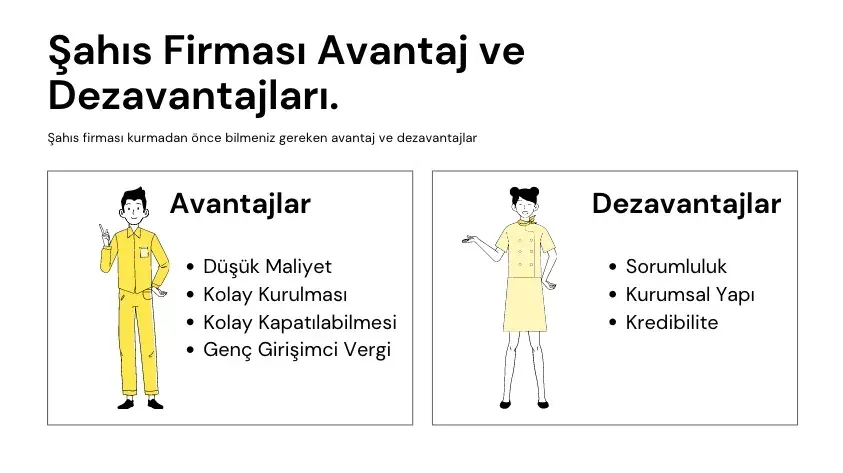
Advantages
- Low formation cost: Among company types, it can be set up with the least capital and expense.
- Fast formation: Once the required documents are ready, the process from application to receiving the tax certificate is typically completed within a few business days.
- Easy to close: When it’s time to wind down, closing a sole proprietorship requires far fewer procedures than a limited company.
- Eligible for the young entrepreneur exemption: For entrepreneurs under 29 who meet the conditions, the income tax exemption applies specifically to the sole proprietorship structure.
Disadvantages
- Unlimited liability: As explained above, business debts extend to personal assets.
- Lack of corporate structure: A sole proprietorship has a much more limited legal framework than a limited company for matters like partnership structure or transferring ownership stakes.
- Credibility perception: In bank financing, corporate client relationships, or investor conversations, some parties may find a limited or joint-stock structure more reassuring.
How Does the Formation Process Work?
The core steps for forming a sole proprietorship are:
- Determining your line of business and business address. Your activity code (NACE code) directly affects the tax rules and incentives you’ll be subject to.
- Filing the start-of-activity notice with the tax office. This notice marks the official start of your tax registration.
- Certifying the required books and setting up your bookkeeping. Cash-basis bookkeeping is sufficient for most sole proprietorships.
- Receiving your tax certificate. This is the official registration document that must be displayed at your place of business.
With the right documents in hand, this entire process can typically be completed within two business days.
Which Entrepreneur Profile Does This Suit?
A sole proprietorship is a solid starting point especially for:
- Solo freelancers starting at low volume (consultants, designers, translators)
- Entrepreneurs who want to test a business idea at low cost first
- Entrepreneurs under 29 planning to use the young entrepreneur exemption
If you’re planning a multi-founder structure, bringing in investors, or focusing on corporate clients or public tenders, a limited company structure may be the better fit. We cover the detailed comparison between the two structures in our sole proprietorship vs. limited company guide.
Why Choosing the Right Structure Matters
Consulting an accountant when deciding on the company type that fits your business model affects not just your formation process, but your tax burden and growth flexibility in the years ahead. We evaluate this decision together based on your current income level and your three-to-five-year goals.
How We Support This
For entrepreneurs looking to set up a sole proprietorship, we clarify the line of business, the business address, and young entrepreneur exemption eligibility in the first meeting. We then manage the entire application process on your behalf and deliver your tax certificate as quickly as possible.
Accounting and tax advisory in Şişli and Mecidiyeköy
If you want tailored support on this topic, we can meet in person at our Şişli office or through digital channels.
Related services
- #sole proprietorship
- #company formation
- #entrepreneurship
- #tax certificate
Want Advice Tailored to Your Situation?
Fill out the form for an assessment specific to your business, or call us directly — we'll get back to you within 24 hours.