
Key Takeaways
- In dropshipping, inventory and storage risk sit with the supplier; the seller manages only the order and the customer relationship.
- Low startup cost is an advantage, but limited control over product quality and delivery time is the biggest risk.
- VAT and income/corporate tax work under the standard rules for whatever company type the seller has set up; using a foreign supplier can add extra procedures.
- The supplier's invoice is booked as an expense; the invoice issued to the customer is booked as revenue on the full sale price.
Dropshipping is one of the e-commerce models that keeps growing worldwide. It’s also known as “no-inventory selling” because the seller never physically holds the product they’re selling. The appeal lies in the low startup cost — but there are bookkeeping and tax details worth understanding before you start.
How Does Dropshipping Work?
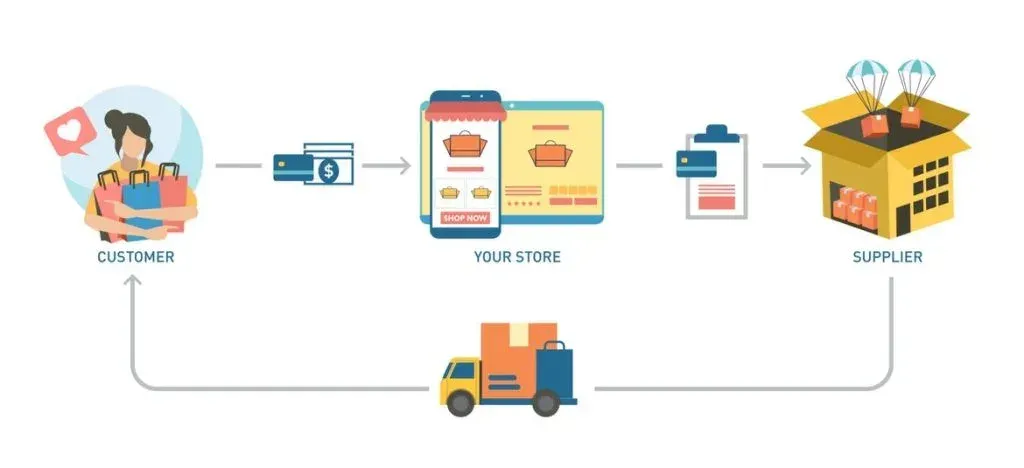
The model bridges three parties: the customer, the seller (your store), and the supplier. The flow runs like this:
- The customer orders a product from your online store and pays you.
- You forward that order to the supplier who stocks the product, and pay the supplier’s price.
- The supplier ships the product directly from their own warehouse to the customer — it never passes through your hands.
Your added value in this flow is finding the right product, marketing your store, and managing the customer relationship. The operational load of storage, packaging and shipping sits with the supplier.
Advantages
- Low startup cost: With no product purchasing, storage or inventory risk, the capital required is far lower than classic e-commerce.
- Broad product range: Working with multiple suppliers lets you offer a wide catalog without carrying stock.
- Geographic flexibility: There’s no restriction on working with domestic or foreign suppliers.
Disadvantages and Risks
- Quality control is hard: Since you never see the product yourself, you often only learn about quality issues once a customer complains.
- Delivery time uncertainty: Shipping times can stretch, especially with foreign suppliers, directly affecting customer satisfaction.
- High competition: Multiple sellers may work with the same supplier, driving intense price competition.
- Commission and advertising costs: Marketplace commissions combined with customer acquisition (ad) costs can compress your margin.
Managing these risks comes down to the quality of your supplier vetting: working with suppliers who honor delivery commitments, handle returns/exchanges transparently, and keep stock status current is what determines whether the business is sustainable.
How Does the Bookkeeping Work?
Two separate invoice flows exist in dropshipping, and they shouldn’t be conflated:
- The supplier’s invoice: Booked as an expense. This represents the cost of the goods sold.
- The invoice issued to the customer: Booked as revenue, on the full sale price.
A common mistake is assuming VAT applies only to the margin — the difference between supplier cost and sale price. In fact, VAT is calculated on the entire sale price; the VAT on the supplier’s invoice is what goes into your deductible VAT.
When the Supplier Is Abroad
If your supplier is overseas, the transaction may qualify as an import, bringing in customs duty and import VAT. If your customer is abroad and the goods ship directly from the foreign supplier to the foreign customer (a triangular-trade-like structure), different VAT treatment may apply. In these scenarios, correctly classifying the parties and the movement of goods is critical to applying the right tax treatment.
Which Company Type Should You Start With?
The tax rules that apply once you start dropshipping follow the standard regime for whatever company type you’ve set up — there’s no dropshipping-specific tax regime. For entrepreneurs starting at low volume, a sole proprietorship is usually the more suitable starting point; converting to a limited company can be considered as volume grows. For a detailed comparison of company types, see our sole proprietorship vs. limited company guide.
How We Support This
For clients running a dropshipping business, we make correct classification of supplier and customer invoices, VAT calculated on the full sale price, and correct exemption/import handling for foreign supplier or customer scenarios a standard part of the monthly bookkeeping process.
Accounting and tax advisory in Şişli and Mecidiyeköy
If you want tailored support on this topic, we can meet in person at our Şişli office or through digital channels.
Related services
- #dropshipping
- #e-commerce
- #no-inventory selling
- #supplier
- #bookkeeping
Want Advice Tailored to Your Situation?
Fill out the form for an assessment specific to your business, or call us directly — we'll get back to you within 24 hours.